
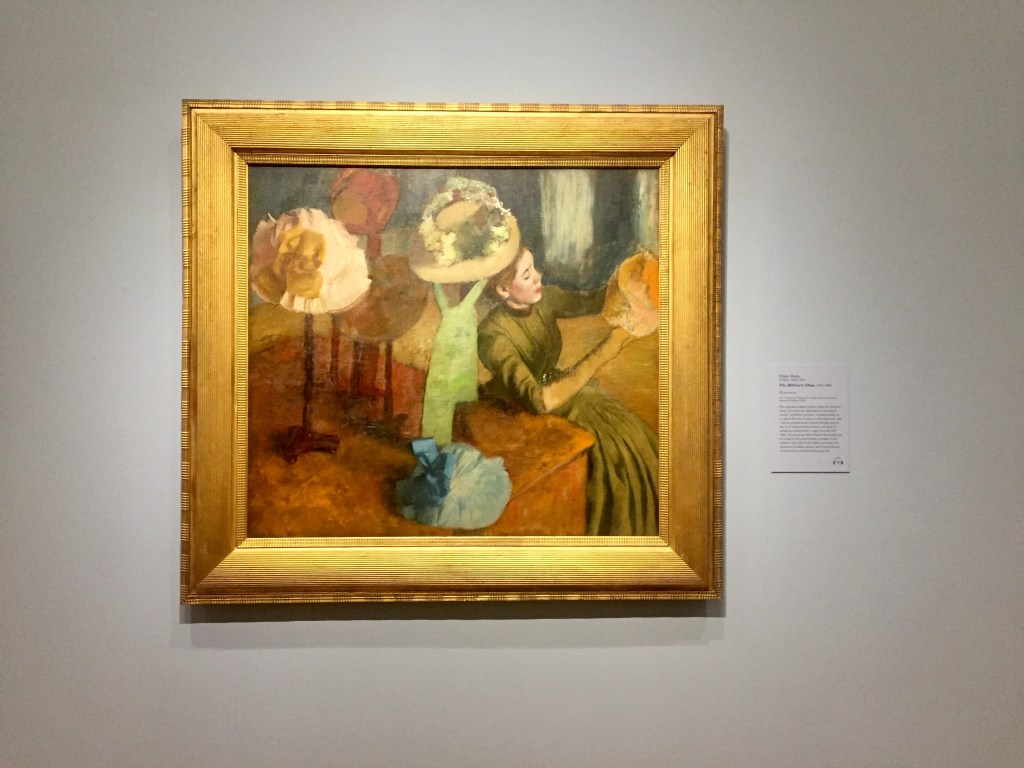
The Degas, Impressionism, and the Paris Millinery Trade exhibit was on view at the Legion of Honor Museum in San Francisco and it was an absolute blast. It was fascinating to see the intersection between art, hats, social class and the economy between the mid 1870s to 1914.
Each hat was meticulously crafted; the more distinct it was, the more telling it was of the wearer’s social status. These hats were adorned with plumes (the more exotic the feather, the more socially important the wearer), seasonal flowers and ribbons. Millinery shops created a hierarchy of workers, most of which were women, thus influencing gender roles and giving working women the freedom and capital to spend their earnings as they wished.
Aside from the societal and monetary impact of the millinery trade, I found myself wistfully contemplating how it would feel like to time travel back to a time when colors and sequins were matched perfectly, there existed spaces for women to gab about hat styles and designs, and live in Paris at a time when taking time to create a hat was looked upon with intrigue by Degas, Manet, Beraud, Renoir and others. There is something sacred and pristine about artists’ obsession with hat makers. It almost feels meditative to view impressionistic painting after painting of women stitching hats, trying on hats, or posing with hats. It is as if the same moment is captured repeatedly in a ritualistic way in order to capture not only the artisan’s devotion, but a moment in time when all of one’s worries and frustrations can melt away in order to create a work of art as beautiful and intricate as a hat.
#DegasMillinery

 Une Pause