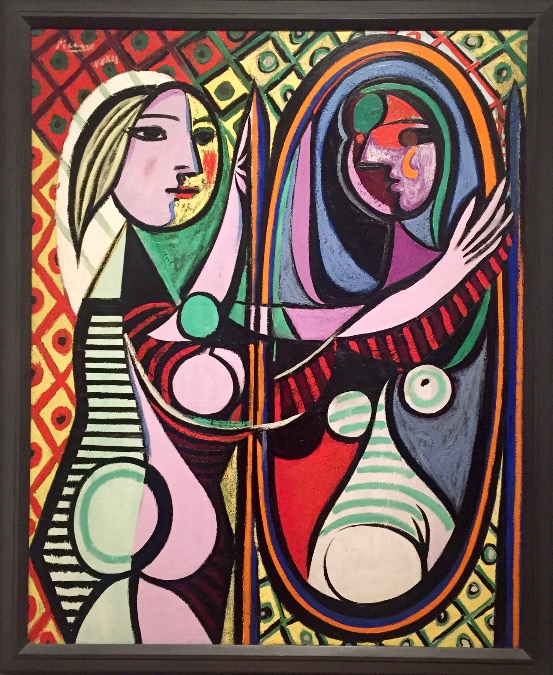
I’ve always been intrigued by pieces that ask us how we see ourselves. Girl Before a Mirror, Pablo’s piece painted in 1932, affords us such a view. In his case, it’s his mistress looking at herself, and he paints what he sees happening inside and outside of her.
What does she see when she takes a gander? I ask quizzically. Does she see battle scars or insurmountable wounds? A light, airy light within or a deep sense of doom and gloom? An iron determination or death, decay and resignation?
It has been my experience that the way we see ourselves and define our narrative directly affects our journey and the energy emanates from us into the universe. There are countless folks in my life I can point to who have embodied this; used their powerful, personal and poignant experiences to create a narrative that fuels their journey in a way that is similar to what Edward Bloom did in The Big Fish and Pi Patel did in Life of Pi. I’ve often wondered whether this determined, tenacious and ultimately unshakable faith in oneself is the secret to success of people who have braved unthinkable injustices and gut-wrenching tortures in the face of seemingly unbeatable odds.
* * * *
“They say when you meet the love of your life, time stops, and that’s true. What they don’t tell you is that when it starts again, it moves extra fast to catch up.”
And thus Edward Bloom spends months, possibly years working in tough conditions in order to learn one fact per month about his beloved Jenny. Well, at least that’s what the movie version of Big Fish leads us to believe. Factually, the situation is grueling and unbearable, but shared whimsically, Edward’s reliance on frilled and colorful characters lends this trying time of his life a beauty that helps makes the unbearable time more bearable.
Did his narrative give him the strength to survive an otherwise tough life that involved him being on the road, away from home most of the time? Do these narratives create a sense of greatness that Edward wants his son to remember him by?
****
When I think of the most impactful and significant parts of my life a few themes resonate; love and loss. Love, to an indescribable degree, and loss of an emptying, hollowing extent. When I reflect on those moments, I realize that the ability to create a narrative and essentially make sense of what happened comes from knowing that phase of your life is over. The narrative comes from acknowledging to yourself the infinite wisdom of the universe and how ultimately we are tiny beings that have no control of our surroundings. We do have control, however, on how we perceive information and how we feed it to ourselves. Whether it is the most gruesome experience or the most pleasant, the way you remember it – and most importantly your role in it – will either cause the soul to flourish in expansive understanding or diminish in regret.
The power of a narrative is that it gives you the fuel to not only survive, but thrive in your surroundings. It gives meaning to experience and makes it count for something – it is a battle scar that once was a fork in the road, thus making it personal and consequential. Ultimately, a narrative allows us to end a chapter of our life in order to start a new one, signaling empowerment.
Down the road when we choose to look back and muse over the past, the narrative allows us to look at our past from a birds-eye view and understand trends, themes, and symbols, instead of getting stuck on specificity.
And that’s how the greats move mountains without letting the past destroy them.
So getting back to the Girl Before a Mirror – what does she see? It makes all the difference.

 Une Pause