Life has been a topsy-turvy, endlessly winding road recently. Image yourself cruising through a 5 lane highway, only to find that all 5 lanes have merged into one sharp-turning road – a one-way street leading up to a mountain peak! That’s been my life for the last few weeks. No matter what I do, I end up antagonizing a colleague, leaving me feeling confused, hurt, and inadequate.
Events took a groundbreaking turn last week though. For the first time, someone raised their voice at me for a totally unwarranted reason in a professional setting. The groundbreaking part is what happened after – I spoke up for myself. Heart throbbing, palms sweaty, voice heavy with apprehension – I remember the acute sense of fear I felt – yet in the midst of my physical response, I proceeded to speak up and defend myself with a cool, resolved sense of finality that was in all honesty, a surprise. I recognized the source of entitlement this person is coming from and did something about it. After the encounter, which left me shaken and tired, I thought about how this behavior is indicative of a pattern that is developed as to how she processes her stress, forcing myself to think up next steps.
What I did NOT do is allow this verbally abusive situation crumble my confidence. I did not think for one second that I deserved that sort of behavior, and about what I can do to not have this happen to me again. For the first time in my life, I recognized that I cannot make everything better. Call this entitlement, but I didn’t realize that folks who want to “fix everything” and solve everyone’s problems are actually doing it because on some deep level they feel they are owed harmony.
Life does not work this way and for the first time, I understood that. I understood that this colleague’s unprovoked behavior is a result of her unhappiness – the source of which is her, not me. Her attitude to life, how she handles stress and how she ultimately treats those around her is all on her. What I experience during my interactions with her is a result of how she perceives the world – and she is not entitled to treat me that way due to her internal chaos, nor am I entitled to fix it because it’s not my problem.
I need to do what Darwan advises Wendy do in Learning To Drive, as he is teaching her to drive. Though he’s referring to how one should stay vigilant while on the road, his words are a metaphor for how one should read the Universe’s signs as we move from one phase, to another:
“Teach yourself to see everything. Your eyes should go from sidewalk to sidewalk and one block ahead. You see the markings on the road, the lights, you read the signs.”
When Wendy complains that there are too many signs to read, Darwan responds that vigilance “comes with time. Be aware of living as well as nonliving things. When you see a person ahead of you, try to guess what they’ll do next [because] you can’t always trust people to behave properly.”
Experience the world as a traveler and Universe’s winding roads as a sign to take the next leap. Stay in your lane, don’t get stuck in the weeds (the why and hows) and keep moving forward – take the 3,000 foot, aerial approach to life and remember that by subjecting us to chaos, pain, and disorientation, the Universe jolts us into growing into where we are headed next. There’s nothing like rough winds and tumultuous waters to force us to evaluate where we are going – and whether it’s time to change course.
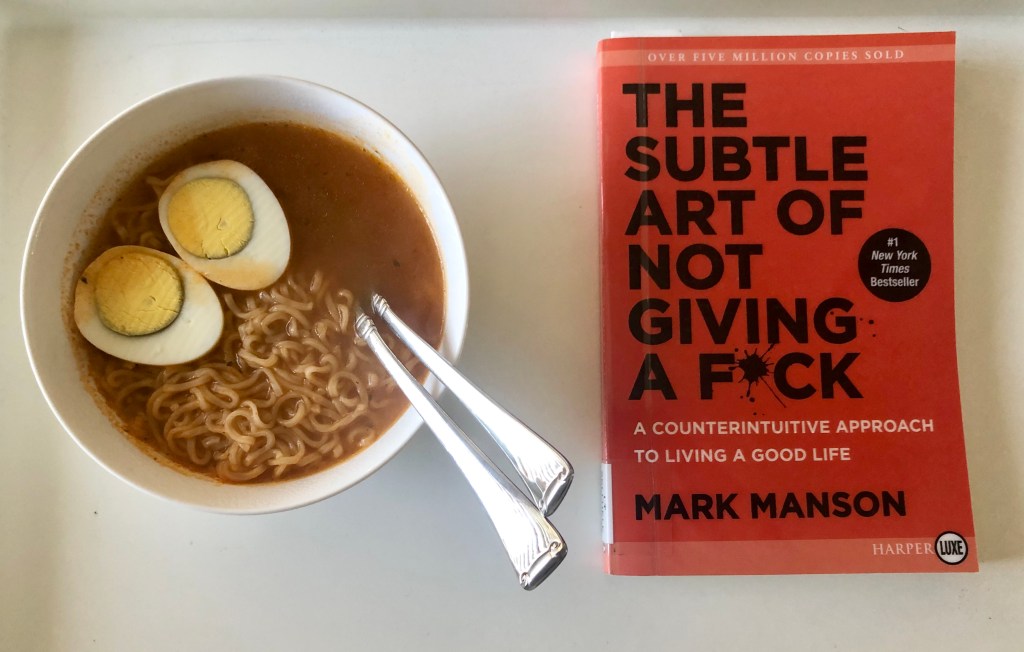
In The Subtle Art of Not Giving A Fuck, Mark Manson does an amazing job breaking down why people are the way they are, in the most simple, easy-to-understand way possible. He talks about how people who are constantly unhappy and relish sharing their woes with the world are highly attention-seeking individuals that feel entitled – entitled that they are owed something: whether it’s a healthy environment from the world, sympathy from their friends, or total submission from a subordinate.
But life doesn’t work that way. Relationships are a two-way dance of give and take that need to be based on trust, respect and boundaries in order for them to work. When someone has proven themselves to be ungrateful, unappreciative, and undeserving of our efforts, does it make sense to keep giving 200% of ourselves?
No. It makes zero sense to keep delivering excellence when the response is critique and ungratefulness.
Entitlement sets us up for failure, and it was the word that was buzzing through my mind when my colleague was rude to me.
When we truly recognize the situation for what it is –an opportunity to grow – we begin to invest our energies getting to the next phase of our life. Instead of getting bogged down in the whys (why did this happen to me? Another form of entitlement), we accept the hand we are dealt, decide to move forward and open our arms wide to allow the Universe to work its bountiful magic:
“The beauty of poker is that while luck is always involved, luck doesn’t dictate the long-term results of the game. A person can get dealt terrible cards and beat someone who was dealt great cards. Sure, the person who gets dealt great cards has a higher likelihood of winning the hand, but ultimately the winner is determined by – yup, you guessed it – the choices each player makes throughout play.
I see life in the same terms. We all get dealt cards. Some of us get better cards than others. And while it’s easy to get hung up on our cards, and feel we got screwed over, the real game lies in the choices we make with those cards, the risks we decide to take, and the consequences we choose to live with. People who consistently make the best choices in the situations they’re given are the ones who eventually come out ahead in poker, just as in life.
There are those who suffer psychological and emotionally from neurological and/or genetic deficiencies. But this changes nothing. Sure, they inherited a bad hand and are not to blame. No more than the short guy wanting to get a date is to blame for being short. Or the person who got robbed is to blame for being robbed. But it’s still their responsibility. Whether they choose to seeks psychiatric treatment, undergo therapy, or do nothing, the choice is ultimately theirs to make. There are those who suffer through bad childhoods. There are those who are abused and violated and screwed over, physically, emotionally, financially. They are not to blame for their problems and their hindrances, but they are still responsible – always responsible – to move on despite their problems and to make the best choices they can, given their circumstances.
And let’s be honest here. If you were to add up all of the people who have some psychiatric disorder, struggle with depression or suicidal thoughts, have been subjected to neglect or abuse, have dealt with tragedy or the death of a loved one, and have survived serious health issues, accidents, or trauma – if you were to round up all of those people and put them in the room, well, you’d probably have to round up everyone, because nobody makes it through life without collecting a few scars on the way out.
Sure, some people get saddled with worse problems than others. And some people are legitimately victimized in horrible ways. But as much as this may upset us or disturb us, it ultimately changes nothing about the responsibility equation of our individual situation.” (p. 131 – 133)
Take ownership of your happiness and realize that you have a choice to improve your situation. You always have a choice. Decide to stay in your lane, focus on yourself, and progress onwards with life.
If you are experiencing uncertainty and hardship, keep faith – in yourself, in your ability to choose your path, and the Universe’s ability to avail you the right path. Think of problems as clues to your next destination, and be open to experiencing the Universe’s magic.

 Une Pause